Frequently Asked Questions
The most-asked questions about reaction mechanisms and kinetics.
What is reaction kinetics in a nutshell?
Kinetics is the branch of chemistry that asks how fast a reaction proceeds and what step-by-step pathway it follows from reactants to products. It complements thermodynamics, which only tells you whether a reaction is favorable, by revealing the speed and the route.
Who are the key historical figures everyone references?
Svante Arrhenius (1889 rate-temperature relationship), Jacob van 't Hoff (early equilibrium-and-rate work), and Henry Eyring together with Michael Polanyi (1935–36 transition-state theory) form the core pantheon. Modern mechanistic organic chemistry also leans heavily on the work of Ingold, Hughes, and Ingold's successors in the mid-20th century.
Where should a newcomer start?
Work through the Arrhenius equation, activation energy, and simple rate laws before tackling multi-step mechanisms or steady-state approximations. A standard physical-chemistry text (Atkins, Laidler, or Levine) paired with a dedicated kinetics problem set is the usual on-ramp.
What's the difference between a rate law and a mechanism?
A rate law is the experimentally measured equation that links the reaction rate to reactant concentrations. A mechanism is the proposed sequence of elementary molecular events that explains why the rate law has that particular mathematical form.
What is the transition state and why is it such a central concept?
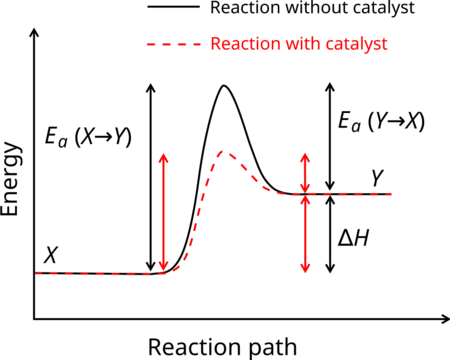
The transition state is the highest-energy, saddle-point arrangement of atoms along the reaction coordinate, where old bonds are partially broken and new ones partially formed. Its structure and energy largely dictate both the speed and the selectivity of the reaction, making it the focal point of nearly every mechanistic discussion.
What does the Arrhenius equation actually tell you?
It writes the rate constant as k = A·e^(−Ea/RT), showing that the fraction of encounters energetic enough to cross the barrier falls off exponentially as activation energy rises or temperature drops. The pre-exponential factor A accounts for collision frequency and the geometric probability of a productive orientation.
Why can't I just read the mechanism straight off the balanced equation?
A balanced equation is a net summary, while a mechanism consists of one or more elementary steps—single molecular events like a unimolecular decomposition or a bimolecular collision. Because most reactions proceed through intermediates, the stoichiometric coefficients in the overall equation generally do not equal the exponents in the rate law.
How do catalysts show up in a mechanism?
A catalyst enters an early step, is consumed, and is regenerated in a later step, opening an alternate pathway with a lower activation barrier. In the resulting rate expression it often appears as a first-order factor or in a denominator term, depending on whether the catalytic cycle is saturated or not.
What are the iconic mechanisms every fan knows by name?
The SN1/SN2 substitution pair, the E1/E2 elimination pair, radical chain cycles (initiation–propagation–termination), and the Michaelis–Menten enzyme mechanism are the canonical examples that recur in virtually every kinetics and organic-chemistry course.
What counts as a landmark moment in the field's history?
The 1935 formalization of transition-state theory by Eyring, Evans, and Polanyi gave chemists a thermodynamic bridge to rate constants, transforming kinetics from a purely empirical discipline. The 1999 Nobel Prize to George Olah for isolating stable carbocations similarly reshaped how mechanists think about cationic intermediates.