Sigma bond
Strongest covalent bond formed by direct orbital overlap.

Sigma bonds (σ bonds) are the strongest type of covalent chemical bond, formed by head-on overlapping between atomic orbitals along the internuclear axis. They are fundamental to the structure of diatomic and polyatomic molecules, providing the primary bonding framework in single, double, and triple bonds.
- type
- covalent chemical bond
- strength
- strongest type of covalent bond
- formation
- head-on overlapping of atomic orbitals along the internuclear axis
- symmetry
- symmetrical with respect to rotation about the bond axis
- common_forms
- s+s, pz+pz, s+pz, dz2+dz2
- bond_count_rule
- Nσ = Natoms + Nrings − 1
Lore & Background
Sigma bonds are defined for diatomic molecules using symmetry groups, where a σ-bond is symmetrical with respect to rotation about the bond axis. Common forms include s+s, pz+pz, s+pz, and dz2+dz2. Quantum theory indicates that molecular orbitals of identical symmetry mix or hybridize, blending wavefunctions such as s+s and pz+pz, with the extent depending on relative energies.
Reader's Guide
Sigma bonds are the strongest type of covalent bond due to direct orbital overlap, and the electrons in these bonds are sometimes referred to as sigma electrons. Typically, a single bond is a sigma bond, while multiple bonds consist of one sigma bond plus pi or other bonds. The concept extends to polyatomic molecules, where sigma bonds are obtained by head-on overlapping of atomic orbitals. The sigma bond rule, Nσ = Natoms + Nrings − 1, applies to many organic molecules but fails for structures like Buckminsterfullerene due to graph topology considerations.
Did You Know?
- Sigma bonds are the strongest type of covalent chemical bond.
- A sigma bond is symmetrical with respect to rotation about the bond axis.
- The sigma bond rule states that the number of sigma bonds equals the number of atoms plus the number of rings minus one.
- For homodiatomics, bonding σ orbitals have no nodal planes between the bonded atoms, while antibonding σ* orbitals have one nodal plane.
Frequently Asked Questions
Who is Sigma bond?
Sigma bond is the strongest covalent bond in the chemical canon, born from a direct head-on overlap of two atomic orbitals along the internuclear axis. It serves as the primary structural link in every single bond and as the first component of any double or triple bond.
What are Sigma bond's powers and role?
Its signature power is cylindrical symmetry: the electron cloud looks identical no matter how you rotate the molecule around the bond axis. It appears in several common overlap forms, including s+s, pz+pz, s+pz, and dz2+dz2, making it versatile across the periodic table.
How does Sigma bond's story end in a reaction?
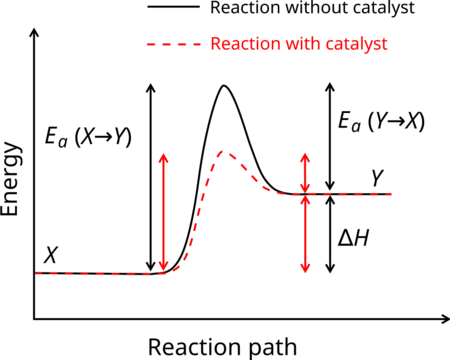
In kinetic mechanisms, sigma bonds are typically the last to break within a multiple bond because of their superior strength, often demanding the highest activation energy for cleavage. Their rupture—whether homolytic or heterolytic—frequently marks the rate-determining step of a reaction.
Why is Sigma bond so important to the canon?
It provides the foundational bonding framework for both diatomic and polyatomic molecules; without it, the structural skeleton of matter simply collapses. The counting rule Nσ = Natoms + Nrings − 1 underscores that every connected molecule in the encyclopedia depends on it.
What is Sigma bond's signature move?
Its defining move is the frontal, head-on orbital overlap along the internuclear axis, which is precisely what makes it stronger than any pi bond in the same linkage. This direct approach is why it is always the first bond formed and the last one broken in a given connection.
More in Reaction Mechanisms And Kinetics 25-35
Elsewhere in the Reaction Mechanisms And Kinetics universe
Spotted an error? Know more?
This is a living reference — every entry is fact-audited, and reader corrections feed straight into our audit queue. Suggest an edit · See this site's audit record