Transition state
Highest-energy configuration along a reaction coordinate.

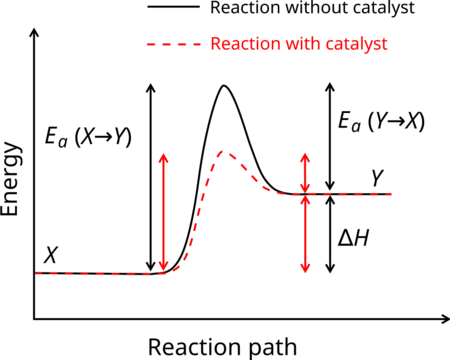
The transition state of a chemical reaction is a particular configuration along the reaction coordinate, defined as the state corresponding to the highest potential energy along this coordinate. It is often marked with the double dagger (‡) symbol.
- field
- Chemistry
- key_concept
- Highest potential energy state along reaction coordinate
- symbol
- Double dagger (‡)
- associated_theory
- Transition state theory (activated complex theory)
Lore & Background
The transition state is a first-order saddle point on a potential energy surface, meaning it is a minimum in all directions except one. Because of this, the population of species at the transition state is negligible, and its existence is fleeting, lasting only on the timescale of chemical bond vibrations (femtoseconds). Spectroscopic techniques such as femtochemical IR spectroscopy have been developed to probe molecular structure extremely close to the transition point.
Reader's Guide
The transition state is central to understanding chemical reaction rates. According to transition state theory, once reactants pass through the transition state configuration, they always continue to form products. However, a collision between reactant molecules may form an activated complex that can either proceed to products or fall apart back to reactants. The Hammond–Leffler postulate states that the structure of the transition state more closely resembles either reactants or products, depending on which is higher in enthalpy. In enzymatic catalysis, stabilizing the transition state through electrostatics lowers its energy, allowing more starting material to overcome the transition energy and form products. The structure–correlation principle shows that structural changes along the reaction coordinate can be observed in ground-state bond lengths, as demonstrated in bicyclic compounds undergoing retro-Diels–Alder reactions.
Did You Know?
- The transition state is often marked with the double dagger (‡) symbol.
- The population of species at the transition state is negligible because it is a first-order saddle point on the potential energy surface.
- Femtochemical IR spectroscopy can probe molecular structure extremely close to the transition point.
More in Reaction Mechanisms And Kinetics 1-24
Elsewhere in the Reaction Mechanisms And Kinetics universe
Spotted an error? Know more?
This is a living reference — every entry is fact-audited, and reader corrections feed straight into our audit queue. Suggest an edit · See this site's audit record