Leaving group
Fragment that departs with an electron pair in heterolytic cleavage.

In organic chemistry, a leaving group is a molecular fragment that departs with an electron pair during a reaction step involving heterolytic bond cleavage. The term is a less formal synonym of nucleofuge, though IUPAC gives a broader definition that includes groups departing without an electron pair (electrofuges) and those in homolytic cleavage. Leaving group ability affects reaction rate and mechanism, depending on context and the group's capacity to stabilize additional electron density.
- field
- Organic chemistry
- known_for
- Influence on reaction rate and mechanism; correlation with pKaH of conjugate acid; common anionic leaving groups include Cl−, Br−, I−, and sulfonate esters; neutral leaving groups include water, alcoh
Lore & Background
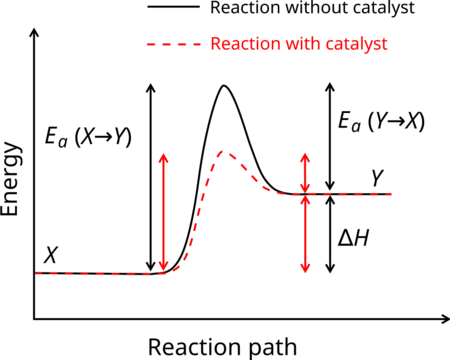
Leaving group ability manifests physically in fast reaction rates and low activation barriers. Because the leaving group often gains negative charge in the transition state, good leaving groups stabilize this charge and form stable anions. Strong bases such as OH−, OR−, and NR2− tend to be poor leaving groups, while extremely weak bases like OSO2CH3− leave easily. The correlation between leaving group ability and the dissociation constant of the conjugate acid (pKaH) is not perfect, as leaving group ability is a kinetic phenomenon while acidity is thermodynamic.
Reader's Guide
Leaving groups are central to understanding reaction mechanisms in organic chemistry. Their ability to depart influences whether a reaction proceeds at a meaningful rate and what pathway it follows. For SN2 reactions, typical synthetically useful leaving groups include Cl−, Br−, I−, tosylate, mesylate, triflate, and water. In SN1 and E1 reactions, poor leaving groups can be activated by protonation or complexation with a Lewis acid. Context-dependence is significant: in SNAr reactions, fluoride can be a better leaving group than other halides due to its electron-withdrawing effect in the rate-determining step. Even very poor leaving groups like hydride or carbanions can depart in specific reactions such as the Chichibabin, Wolff-Kishner, or Haller-Bauer reactions. The concept extends to super leaving groups like triflate and hyper leaving groups such as diaryl iodonium salts, which can be displaced by extraordinarily weak nucleophiles.
Did You Know?
- IUPAC defines a leaving group as any group that detaches from the main substrate during a reaction step, including electrofuges like H+ or SiR3+.
- Hydride (H−) serves as a leaving group only extremely rarely, as in the Chichibabin reaction.
- In SNAr reactions, fluoride can increase reaction rate relative to other halogens due to its electron-withdrawing ability in the rate-determining step.
- Super leaving groups like triflate can autoionize if the electrofuge forms a stable carbocation.
The Two-Step Pathway and Its Structural Prerequisites
The E1cB mechanism unfolds through a distinctive two-step sequence that sets it apart from other elimination pathways. In the first step, a base—typically moderate to strong—abstracts a proton from the β-carbon, generating a stabilized anionic intermediate such as a carbanion; this step may or may not be reversible. In the second step, the lone pair of electrons on that anion migrates toward the neighboring atom, expelling the leaving group and producing a double or triple bond. Two structural prerequisites must be met for this pathway to dominate: the substrate must possess a relatively acidic hydrogen on its β-carbon and a poor leaving group (such as -OH or -OR) on the α-carbon. The stability of the anionic intermediate is crucial to the mechanism's feasibility; it can be reinforced through inductive effects or resonance delocalization of the electron pair. Electron-withdrawing groups on the substrate, a strong base, a poor leaving group, and a polar solvent collectively create the conditions that favor this mechanistic route.
A Position on the Elimination Spectrum
Rather than existing as an isolated mechanism, E1cB occupies one extreme of a continuous spectrum of elimination reactions, with E1 at the opposite end and E2 in the middle. The three pathways are distinguished primarily by the timing of deprotonation relative to leaving-group departure. In E1, a good leaving group (such as -OTs or -Br) departs first, generating a carbocation; the now-vacant p orbital makes the adjacent hydrogen more acidic, and a weak base removes it in a second step. In E2, a strong base and a good leaving group work in concert, with proton abstraction and leaving-group departure happening simultaneously in a single transition state. E1cB inverts this logic: the leaving group is poor, the hydrogen is acidic, and the base acts first. The name itself encodes this—Elimination Unimolecular conjugate Base—where "unimolecular" reflects that the rate-determining step involves only one molecular entity, and "conjugate base" refers to the carbanion intermediate derived from the starting material.
Distinguishing E1cB from Its Kinetic Cousins
Although all three elimination mechanisms remove two substituents to form alkenes, alkynes, or heteroatom analogues, they differ in the sequence and synchrony of bond-making and bond-breaking events. The hallmark of E1cB is the discrete carbanion intermediate, which contrasts with the carbocation of E1 and the single concerted transition state of E2. Experimental evidence for this intermediate comes from studies using different halogen leaving groups: when both chlorine and fluorine are present, chlorine—being a better stabilizer of the anion—remains on the molecule while fluorine departs, even though chlorine is the superior leaving group. This outcome is impossible under a purely concerted E2 pathway, confirming that a carbanion forms first. Ultimately, the most reliable method for assigning a mechanism to a given reaction is chemical kinetics, particularly rate-law analysis and the kinetic isotope effect, which can discriminate among E1cB, E1, and E2 pathways where structural arguments alone fall short.
Scope Beyond Simple Carbon Eliminations
While E1cB is most commonly discussed in the context of carbon-based eliminations, its scope extends well beyond that. The mechanism has been observed with heteroatoms such as nitrogen, as illustrated by the atmospheric degradation of ethiofencarb, a carbamate insecticide with a relatively short environmental half-life. In that case, deprotonation of the amine yields an amide intermediate stabilized by conjugation with a neighboring carbonyl group, making the pathway particularly favorable. Another notable tendency is that E1cB appears more frequently in eliminations producing alkynes from alkene precursors than in simpler alkane-to-alkene conversions. One proposed explanation is that sp2 hybridization renders the relevant protons slightly more acidic, lowering the energetic barrier for the initial deprotonation step. Compounds bearing poor leaving groups such as alcohols and fluoroalkanes are classic substrates, and the mechanism is not restricted to any single element or bond type, underscoring its generality across organic and heteroatom chemistry.
Frequently Asked Questions
Who is Leaving group?
A leaving group is a molecular fragment that departs carrying the bonding electron pair when a bond undergoes heterolytic cleavage during a reaction step. In IUPAC nomenclature the broader term is nucleofuge, but the informal label 'leaving group' is what you will see in virtually every organic-chemistry discussion.
What are Leaving group's powers/role?
Its job is to detach from the substrate while taking the shared electron pair with it, thereby generating a reactive intermediate or opening the way for a new bond to form. The ease with which it departs directly governs both the speed and the mechanistic pathway of the overall transformation.
How does Leaving group's story end?
After it breaks away, the fragment typically persists as a stable anion—such as chloride, bromide, iodide, or a sulfonate ester—or as a neutral molecule like water or an alcohol. Its capacity to comfortably accommodate the extra electron density is what makes the departure energetically favorable.
Why is Leaving group important?
The quality of the leaving group is one of the single most critical determinants of reaction rate and mechanism in substitution and elimination chemistry. A poor leaving group can slow a reaction to a crawl or force the system onto an entirely different mechanistic pathway.
What are Leaving group's closest allies?
The most commonly encountered anionic leaving groups are the halides Cl⁻, Br⁻, and I⁻, along with sulfonate esters such as tosylate or mesylate. On the neutral side, water and simple alcohols also fill this role in many acid-catalyzed processes.
More in Reaction Mechanisms And Kinetics 1-24
Elsewhere in the Reaction Mechanisms And Kinetics universe
Spotted an error? Know more?
This is a living reference — every entry is fact-audited, and reader corrections feed straight into our audit queue. Suggest an edit · See this site's audit record