Organic reaction
Chemical reactions involving organic compounds for synthesis and production.

Organic reactions are chemical reactions involving organic compounds. The basic types include addition, elimination, substitution, pericyclic, rearrangement, photochemical, and redox reactions. They are used in the construction of new organic molecules, and the production of many man-made chemicals such as drugs, plastics, food additives, and fabrics depends on organic reactions.
Lore & Background
The oldest organic reactions are the combustion of organic fuels and saponification of fats to make soap.
Reader's Guide
Organic reactions are fundamental to organic chemistry, enabling the construction of new molecules and the production of drugs, plastics, food additives, and fabrics. They are classified by type of reagent, mechanistic class, functional group, and carbon framework changes. The three main mechanistic classes are polar, radical, and pericyclic, with transition-metal mediated reactions often considered a fourth category. Factors governing these reactions include conjugation, hyperconjugation, aromaticity, and the stability of reactive intermediates such as free radicals, carbocations, and carbanions. Selectivity—regioselectivity, diastereoselectivity, and enantioselectivity—is crucial.
Did You Know?
- The oldest organic reactions are combustion of organic fuels and saponification of fats to make soap.
The Theoretical Architecture of a Mechanism
A reaction mechanism is fundamentally a step-by-step sequence of elementary reactions that together account for an overall chemical transformation. Crucially, it is a theoretical conjecture rather than a directly observed phenomenon—in most cases, the individual steps cannot be witnessed experimentally. A proposed mechanism earns its place because it is thermodynamically feasible and backed by experimental evidence, such as the isolation of intermediate species or other quantitative and qualitative observations. A complete mechanism must account for every reactive intermediate, activated complex, and transition state involved. It must specify which bonds are broken and formed, and in what sequence. Beyond bond changes, it must also rationalize why particular reactants and catalysts are employed, explain the stereochemistry observed in both starting materials and products, and account for all products formed along with their relative amounts. The electron or arrow-pushing method is the standard visual language for depicting these mechanisms, as seen in classic examples like Michael addition and benzoin condensation.
Intermediates and Transition States
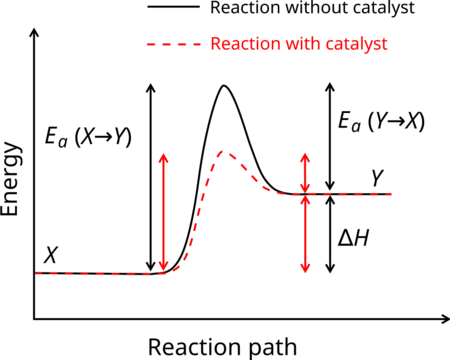
Reaction intermediates occupy a fascinating middle ground in a mechanism. They are chemical species—often unstable and short-lived—that appear as temporary products or reactants within individual steps, yet they are neither the starting materials nor the final products of the overall reaction. In some cases, these intermediates can actually be isolated and characterized experimentally, which provides crucial support for a proposed mechanism. They are frequently confused with transition states, but the two are fundamentally different. Transition states are fleeting, high-energy molecular configurations that correspond to maxima along the reaction coordinate and to saddle points on the potential energy surface. Unlike intermediates, transition states cannot be isolated under any conditions. The kinetics of a reaction—specifically the relative rates of individual steps and the overall rate equation—are discussed in terms of the energy required to convert reactants into these proposed transition states. This distinction between isolable intermediates and unobservable transition states is central to how chemists validate or reject mechanistic proposals.
Kinetics as a Window into Mechanism
Chemical kinetics serves as one of the most powerful tools for inferring reaction mechanisms. By determining the reaction order with respect to each reactant, chemists can deduce which species participate in the rate-determining step. A classic illustration is the oxidation of carbon monoxide by nitrogen dioxide. The experimentally determined rate law depends on the square of the nitrogen dioxide concentration but is independent of carbon monoxide. This reveals that the slow, rate-determining step involves two molecules of nitrogen dioxide colliding, while carbon monoxide enters only in a subsequent fast step. Each individual step in such a mechanism is called an elementary step, carrying its own rate law and molecularity, and the sum of all elementary steps reproduces the net reaction. The slowest step governs the overall rate.
Chain Reactions and the Steady-State Approximation
Chain reactions represent a particularly complex class of mechanisms in which propagation steps form a closed cycle. In such reactions, an intermediate produced in one step generates another intermediate in a subsequent step; these intermediates are called chain carriers and may be radicals, ions, or even neutrons in nuclear fission. A complete chain reaction includes initiation (triggered by thermolysis or photolysis, breaking a bond), propagation (a carrier generating another carrier), branching (one carrier producing multiple carriers), retardation, termination (carriers combining and being lost), and inhibition. The minimum required steps are initiation, propagation, and termination. The thermal decomposition of acetaldehyde into methane and carbon monoxide exemplifies a simple chain reaction with a 3/2 experimental reaction order, explained by the Rice-Herzfeld mechanism. The steady-state approximation—setting the net rate of change of intermediate concentrations to zero—allows chemists to derive the observed rate expression from the individual step rate equations, elegantly connecting microscopic steps to macroscopic kinetics.
Frequently Asked Questions
Who is Organic reaction?
Organic reaction is the broad category of chemical processes in which carbon-containing compounds are transformed. It covers every way an organic molecule can be built, broken, or restructured in the laboratory or in industry.
What are Organic reaction's core abilities?
Its seven principal pathways are addition, elimination, substitution, pericyclic, rearrangement, photochemical, and redox transformations. Together these categories account for virtually every mechanistic class used to manipulate organic molecules.
What role does Organic reaction play in the wider story?
It serves as the fundamental engine for constructing new organic molecules from simpler starting materials. The manufacture of pharmaceuticals, plastics, food additives, and synthetic textiles all depend on organic reactions carried out at scale.
More in Reaction Mechanisms And Kinetics 1-24
Elsewhere in the Reaction Mechanisms And Kinetics universe
Spotted an error? Know more?
This is a living reference — every entry is fact-audited, and reader corrections feed straight into our audit queue. Suggest an edit · See this site's audit record