Isomerization
Process transforming molecules into isomers with different structures.

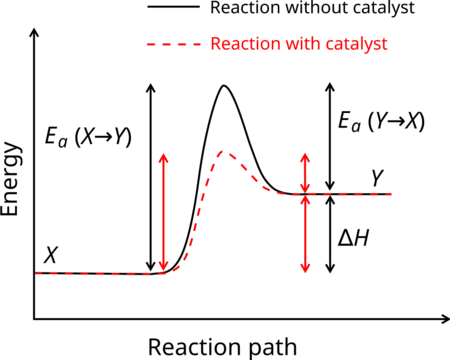
Isomerization is the process in which a molecule, polyatomic ion, or molecular fragment is transformed into an isomer with a different chemical structure. Examples include enolization and tautomerization. When the activation energy for the isomerization reaction is sufficiently small, both isomers can often be observed, and the equilibrium ratio shifts in a temperature-dependent equilibrium with each other.
- field
- Chemistry
- known_for
- Transformation of molecules into isomers with different chemical structures
- applications
- Petrochemical industry, food processing, sugar chemistry, organometallic chemistry, biochemistry
Lore & Background
Isomerization occurs in the cracking process used in the petrochemical industry to convert straight-chain alkanes to isoparaffins, such as the conversion of normal octane to 2,5-dimethylhexane. Fuels containing branched hydrocarbons are favored for internal combustion engines due to their higher octane rating, while diesel engines operate better with straight-chain hydrocarbons. In alkenes, trans-alkenes are about 1 kcal/mol more stable than cis-alkenes, a difference attributed to unfavorable non-bonded interactions in the cis isomer, which helps explain the formation of trans-fats in food processing. Terminal alkenes prefer to isomerize to internal alkenes, a conversion that essentially does not occur in the absence of metal catalysts, and is employed in the Shell higher olefin process.
Reader's Guide
Isomerization is a fundamental chemical process with broad significance across multiple fields. In the petrochemical industry, skeletal isomerization converts straight-chain alkanes to branched isoparaffins, improving octane ratings for gasoline. In food chemistry, the cis-trans isomerization of alkenes underlies the formation of trans-fats. The process is also central to sugar chemistry, where glucose exists in four forms, and to the Lobry de Bruyn–van Ekenstein transformation. In organometallic chemistry, compounds such as (C5H5)2Fe2(CO)4 exist as three isomers in solution, and linkage isomerization occurs in decaphenylferrocene. Biochemically, isomerases are a general class of enzymes that convert molecules from one isomer to another. Kinetic classification divides isomerizations into two categories: those involving transformations between equivalent structures (e.g., cyclohexane ring flip, pyramidal inversion of ammonia, Berry pseudorotation) and those where isomers are nonequivalent (e.g., tautomerizations). Many values of the standard free energy difference have been calculated with good agreement between observed and calculated data.
Did You Know?
- Enolization is an example of isomerization, as is tautomerization.
- Trans-alkenes are about 1 kcal/mol more stable than cis-alkenes due to unfavorable non-bonded interactions in the cis isomer.
- The trans isomer of resveratrol converts to the cis isomer in a photochemical reaction using UV-light.
- Isomerases are a general class of enzymes that convert a molecule from one isomer to another.
The Nature of Isomerization and Its Thermodynamic Landscape
Isomerization is the chemical process by which a molecule, a polyatomic ion, or even a molecular fragment is reorganized into a structurally distinct isomer. This broad category encompasses well-known phenomena such as enolization and tautomerization, in which atoms shift positions while the overall molecular formula remains unchanged. A particularly important feature of isomerization is its relationship to activation energy. When the energy barrier separating two isomeric forms is sufficiently low, both structures can coexist in a dynamic, temperature-dependent equilibrium. As the temperature changes, the ratio of the two isomers shifts in a predictable manner. Scientists have calculated standard free energy differences (ΔG°) for numerous isomerization pairs, and these theoretical values show strong agreement with experimentally observed equilibrium ratios, confirming that the thermodynamic framework reliably captures the behavior of these molecular transformations.
Isomerization in Petroleum Refining and Olefin Chemistry
In the petrochemical industry, skeletal isomerization plays a central role in the cracking process, where straight-chain alkanes are restructured into branched isoparaffins. A classic example is the conversion of normal octane into 2,5-dimethylhexane. The motivation is practical: fuels rich in branched hydrocarbons deliver a higher octane rating, making them ideal for internal combustion engines, whereas diesel engines perform best with straight-chain hydrocarbons. In olefin chemistry, terminal alkenes have a strong thermodynamic preference to isomerize into their internal counterparts, as seen when 1-butene rearranges to 2-butene. However, this conversion essentially does not proceed without metal catalysts. The Shell higher olefin process exploits this principle, converting alpha-olefins into internal olefins that are then channeled into olefin metathesis reactions, creating a valuable industrial pathway for producing specific hydrocarbon products.
Cis-Trans Energetics, Food Chemistry, and Enzymatic Isomerization
The energetic difference between cis and trans alkene isomers, though modest at roughly one kilocalorie per mole, carries significant consequences. Trans-alkenes are more stable than their cis counterparts because the cis geometry introduces unfavorable non-bonded interactions between substituents on the same side of the double bond. This small energetic preference helps explain why trans-fats accumulate during food processing, as the system naturally drifts toward the lower-energy trans configuration. Remarkably, in certain molecules this isomerization can be reversed photochemically; for instance, trans-resveratrol converts to its cis form when exposed to ultraviolet light. In the biological realm, isomerization is carried out by a dedicated class of enzymes called isomerases, which catalyze the conversion of one isomer into another. Sugar chemistry offers a rich illustration: glucose, the most abundant sugar in nature, exists in four distinct forms, and the aldose-ketose interconversion known as the Lobry de Bruyn–van Ekenstein transformation showcases how isomerism threads through saccharide chemistry.
Kinetic Classification and the Diversity of Molecular Motion
From a kinetic standpoint, isomerization falls into two broad categories. The first involves transformations between equivalent structures, a process to which most chemical species are in principle susceptible. This category includes so-called fluxional molecules: the cyclohexane ring flip (chair inversion), the pyramidal inversion of ammonia, the Berry pseudorotation seen in pentacoordinate species such as PF5 and Fe(CO)5, the Cope rearrangements of bullvalene, and the Ray-Dutt and Bailar twists that racemize octahedral complexes bearing three bidentate chelate rings through helical chirality. The second category involves nonequivalent isomers, where one form is inherently more stable than the other. Tautomerizations exemplify this class, spanning keto-enol, lactam-lactim, amide-imidic, enamine-imine, nitroso-oxime, and ketene-ynol interconversions. In organometallic chemistry, the complex (C5H5)2Fe2(CO)4 exists as three solution isomers depending on whether CO ligands are terminal or bridging, and decaphenylferrocene undergoes linkage isomerization, further illustrating the breadth of this phenomenon.
Frequently Asked Questions
Who is Isomerization?
Isomerization is a chemical process in which a molecule, polyatomic ion, or molecular fragment rearranges into a structurally distinct isomer. It sits at the heart of reaction-mechanism and kinetics studies.
What are Isomerization's powers or role?
Its core function is converting one molecular structure into an isomer with a different atom arrangement. Enolization and tautomerization are two of its most well-known subtypes.
How does Isomerization's story end?
When the activation-energy barrier is low enough, both isomers coexist in a dynamic, temperature-dependent equilibrium rather than one fully consuming the other. The equilibrium ratio simply shifts as conditions change.
Why is Isomerization important?
It underlies critical transformations across the petrochemical industry, food processing, sugar chemistry, organometallic chemistry, and biochemistry. Many industrial and biological pathways simply cannot proceed without isomerization steps.
What sets Isomerization apart from other rearrangement reactions?
It specifically yields an isomer—same molecular formula, different structural connectivity—rather than breaking the molecule apart or adding new atoms. Classic examples like tautomerization involve shifting a proton and a double bond within the same framework.
More in Reaction Mechanisms And Kinetics 1-24
Elsewhere in the Reaction Mechanisms And Kinetics universe
Spotted an error? Know more?
This is a living reference — every entry is fact-audited, and reader corrections feed straight into our audit queue. Suggest an edit · See this site's audit record