Rate-determining step
The slowest step that governs overall reaction rate.

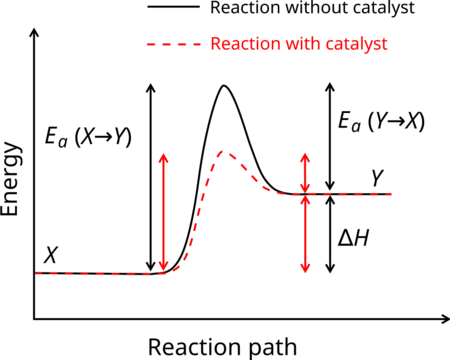
In chemical kinetics, the rate-determining step (RDS or rate-limiting step) is the slowest step in a reaction mechanism, which approximately determines the overall reaction rate. The concept is crucial for simplifying the mathematics of complex reaction mechanisms and for understanding and optimizing chemical processes such as catalysis and combustion.
- field
- Chemical kinetics
- known_for
- Rate-determining step (RDS) approximation
- related_concepts
- Steady-state approximation, pre-equilibrium, reaction mechanism
Lore & Background
The rate-determining step is identified by comparing predicted rate laws for each possible choice with the experimental rate law. For example, in the gas-phase reaction NO2 + CO → NO + CO2, the observed rate equation is r = k[NO2]², indicating a mechanism where two NO2 molecules react in the slow first step, and CO reacts in a subsequent fast step. The intermediate NO3 is formed and consumed, with its concentration estimated using the steady-state approximation.
Reader's Guide
The concept of the rate-determining step is fundamental in chemical kinetics, as it allows the overall rate equation to be derived from a mechanism without solving complex differential equations. In the simplest case, the initial step is the slowest, and the overall rate equals the rate of that step. However, if a later step is rate-determining, a pre-equilibrium may exist, where the first step is fast and reversible. The correct rate-determining step is validated by comparing the predicted rate law with experimental data, as demonstrated with the NO2 and CO reaction, where the second-step rate-determining hypothesis was disproven because it yielded a rate equation inconsistent with experiment.
Did You Know?
- The rate-determining step is also called the rate-limiting step or RD-step.
- For the reaction NO2 + CO, the observed rate is second-order in NO2 and zero-order in CO.
- The steady-state approximation assumes the concentration of a reactive intermediate remains low and almost constant.
- If the second step is rate-determining, the first step may be at equilibrium, forming a pre-equilibrium.
Frequently Asked Questions
Who is Rate-determining step?
The rate-determining step (RDS) is the slowest elementary step within a multi-step reaction mechanism. It acts as the bottleneck that sets the effective pace for the entire reaction sequence.
What is Rate-determining step's role in the mechanism?
It governs the overall reaction rate because every faster step before or after it must wait for this slowest event to finish. Chemists exploit this by writing the rate law using only the species involved in that single slow step, collapsing a complex mechanism into a tractable expression.
How does Rate-determining step's story end?
Once the slow step completes, the remaining faster steps proceed rapidly to deliver the final products. The RDS does not terminate the mechanism on its own; it merely caps the throughput before the sequence wraps up.
Why is Rate-determining step important to the field?
It lets kineticists reduce a complicated multi-step mechanism to a single, manageable rate expression, which is essential for designing catalysts, modeling combustion, and optimizing industrial processes. Without the RDS approximation, deriving rate laws for complex mechanisms would be far more cumbersome.
How does Rate-determining step relate to the steady-state approximation?
Both are simplifying tools for handling multi-step mechanisms, but they target different assumptions. The RDS assumes one step is so much slower that it alone controls the rate, whereas the steady-state approximation assumes a reactive intermediate's concentration remains nearly constant over the course of the reaction.
More in Reaction Mechanisms And Kinetics 1-24
Elsewhere in the Reaction Mechanisms And Kinetics universe
Spotted an error? Know more?
This is a living reference — every entry is fact-audited, and reader corrections feed straight into our audit queue. Suggest an edit · See this site's audit record