Strain (chemistry)
Molecular strain raises internal energy above a strain-free reference.

In chemistry, a molecule experiences strain when its chemical structure undergoes some stress which raises its internal energy in comparison to a strain-free reference compound. The internal energy of a molecule consists of all the energy stored within it. A strained molecule has an additional amount of internal energy which an unstrained molecule does not. This extra internal energy, or strain energy, can be likened to a compressed spring.
- field
- Chemistry
- known_for
- Molecular strain, strain energy, and types of steric and torsional strain
Lore & Background
Strain in a molecule is defined as the additional internal energy it possesses compared to an unstrained reference compound. This strain energy is analogous to a compressed spring, held in place by the molecule's own bonds. The equilibrium between molecular conformations is determined by the difference in Gibbs free energy, with a spontaneous transformation from a higher-energy strained conformation to a lower-energy one. Enthalpy is typically the more important thermodynamic function for determining stability, though entropy can have a larger effect when enthalpy differences are small, as seen in the conformational distribution of n-butane.
Reader's Guide
Strain energy is often determined experimentally using heats of combustion or by comparing a compound's standard heat of formation to a predicted value from Benson group increment theory. Several distinct kinds of strain exist. Van der Waals strain, or steric strain, occurs when atoms are forced closer than their Van der Waals radii allow, with effects studied by Herbert C. Brown in trialkylamines and trimethylboron. Syn-pentane strain arises when two methyl-substituted bonds in n-pentane are rotated to gauche in opposite directions, bringing terminal methyl groups into proximity. Allylic strain, or A1,3 strain, is closely related, as seen in 2-pentene. 1,3-diaxial strain occurs in cyclohexane rings when an axial substituent interacts with axial gamma hydrogens, with the energy difference quantified by the A value. Torsional strain, also called Pitzer strain in cyclic molecules, is the resistance to bond twisting, as in the eclipsed versus staggered conformations of ethane, where recent research suggests hyperconjugation stabilizes the staggered form.
Did You Know?
- Strain energy can be likened to a compressed spring held in place by bonds.
- The anti conformation of n-butane is more stable than gauche by 0.9 kcal mol−1, but entropy favors gauche due to two possible conformations.
- Van der Waals strain occurs when atoms are forced closer than their Van der Waals radii allow.
- The barrier to rotation between staggered conformations of ethane is approximately 2.9 kcal mol−1.
The Catalytic Dance: How Enzymes Transform Substrates
Enzymes, typically denoted as "E" in biochemical notation, are protein molecules that act as biological catalysts, accelerating chemical reactions within cells. Their core function revolves around binding one or more substrate molecules (S) at a specific region called the active site. This binding creates an enzyme-substrate complex (ES), which then progresses through a transition state (ES*) before becoming an enzyme-product complex (EP) and ultimately releasing the product (P) while regenerating the free enzyme. This sequential pathway—E + S ⇄ ES ⇄ ES* ⇄ EP ⇄ E + P—constitutes what is termed the catalytic mechanism. When enzymes handle multiple substrates, as dihydrofolate reductase does, kinetic analysis can reveal the precise order of substrate binding and product release. Proteases, by contrast, take a single protein substrate and cleave it into two polypeptide chains, while DNA polymerase joins a nucleotide onto a growing DNA strand. Despite the complexity of these multi-step processes, there is usually one rate-determining step—whether a chemical transformation or a conformational shift—that governs the overall speed of the reaction.
Saturation and the Ceiling of Speed
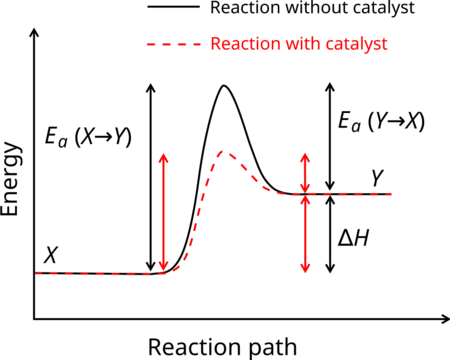
A defining feature that separates enzyme-catalyzed reactions from their uncatalyzed counterparts is saturation kinetics. At low substrate concentrations, the reaction rate climbs in direct proportion to how much substrate is present, because most enzyme molecules remain unoccupied and available to capture incoming substrate. As substrate concentration rises, however, the active sites become increasingly occupied, and the rate begins to level off, asymptotically approaching a theoretical ceiling dictated by the enzyme's intrinsic turnover speed. The substrate concentration at which the reaction velocity reaches exactly half of this maximum is designated KM. Together, the ease with which an enzyme saturates and the maximum rate it can achieve form the two central parameters of enzyme kinetics. Importantly, enzymes do not shift the equilibrium position between substrate and product; they use the same reactants and produce the same products as the uncatalyzed reaction. They simply get there faster. Understanding these two properties—saturation behavior and peak velocity—allows researchers to predict how an enzyme will behave under varying cellular conditions and how its activity might be modulated by inhibitors or activators.
Measuring the Invisible: The Art of the Enzyme Assay
Because enzymes are not consumed during the reactions they facilitate, laboratory assays track the changing concentration of substrates or products over time to quantify reaction rates. Spectrophotometric methods monitor shifts in light absorbance between reactants and products, offering the practical advantage of continuous measurement. Radiometric assays, by contrast, detect the incorporation or release of radioactive labels and require discrete sample removal and counting, making them discontinuous but extraordinarily sensitive for detecting very low enzyme activity. Mass spectrometry provides an analogous route by following stable isotope incorporation as substrate converts to product. At the cutting edge of sensitivity, researchers now focus laser beams through microscopes to watch individual enzyme molecules at work, observing fluorescence changes in cofactors or attached dyes that report conformational movements during catalysis. This single-molecule approach reveals the kinetics and dynamics of one enzyme at a time, in stark contrast to classical assays that report the averaged behavior of millions of molecules simultaneously. When an assay fails, specialized troubleshooting strategies become necessary to revive the measurement.
Beyond Proteins: RNA Catalysts and the Power of Structure
While protein enzymes dominate the conversation, not all biological catalysts are made of amino acids. RNA-based catalysts, including ribozymes and the ribosome itself, carry out essential cellular tasks such as RNA splicing and protein translation. The fundamental distinction is compositional: RNA catalysts are built from nucleotides rather than amino acids, and they perform a more restricted repertoire of reactions. Nevertheless, their mechanisms and kinetic profiles can be analyzed and classified using the same frameworks applied to protein enzymes. Equally important is the contribution of structural biology to kinetic interpretation. Knowing an enzyme's three-dimensional architecture helps researchers understand how substrates and products dock at the active site, what structural changes accompany the reaction, and which specific amino acid residues play mechanistic roles. For enzymes that undergo substantial shape changes during catalysis, it is particularly valuable to determine structures both with and without bound substrate analogues that resist the actual chemical transformation, thereby capturing the enzyme in distinct conformational states.
Frequently Asked Questions
What is strain in chemistry?
Molecular strain occurs when a molecule's geometry is forced into a configuration that stores more internal energy than a relaxed, strain-free reference structure would. This excess energy makes the molecule less stable and more reactive.
What is strain energy?
Strain energy is the extra internal energy a molecule holds beyond what its unstrained counterpart would possess. It is often compared to a compressed spring waiting to release that stored energy.
What are the main types of molecular strain?
The two primary categories are steric strain (atoms or groups forced closer than their ideal van der Waals distances) and torsional strain (eclipsing interactions between bonds along a carbon–carbon axis). Both push the molecule's internal energy above the strain-free baseline.
Why does molecular strain matter for reaction kinetics?
Because a strained molecule sits at a higher energy level, it faces a lower activation barrier to reach a transition state, which typically accelerates the reaction. This is why small rings like cyclopropane react far more readily than their unstrained analogues.
How is molecular strain analogous to a compressed spring?
Both systems store potential energy that is released once the geometric constraint is removed. In a strained molecule, breaking or rearranging the stressed bonds lets that excess internal energy dissipate, much like a spring snapping back to its rest length.
More in Reaction Mechanisms And Kinetics 25-35
Elsewhere in the Reaction Mechanisms And Kinetics universe
Spotted an error? Know more?
This is a living reference — every entry is fact-audited, and reader corrections feed straight into our audit queue. Suggest an edit · See this site's audit record