Valence bond theory
One of two basic quantum theories of chemical bonding.

Valence bond (VB) theory is one of the two fundamental theories in chemistry, alongside molecular orbital (MO) theory, developed to apply quantum mechanics to chemical bonding. It focuses on how atomic orbitals of dissociated atoms combine to form individual chemical bonds when a molecule is created, emphasizing the overlap of half-filled valence atomic orbitals. VB theory provides an intuitive picture of bond formation and has been central to understanding covalent bonding, resonance, and hybridization.
- field
- Chemistry
- known_for
- Describing chemical bonds as overlapping atomic orbitals; resonance theory; orbital hybridization
- key_contributors
- G. N. Lewis, Walther Kossel, Charles Rugeley Bury, Walter Heitler, Fritz London, Linus Pauling
Reader's Guide
Valence bond theory's significance lies in its intuitive, localized picture of chemical bonds as overlapping atomic orbitals, making it accessible for understanding molecular structure and reactivity. It correctly predicts the dissociation of homonuclear diatomic molecules into separate atoms, unlike simple MO theory. VB theory also explains aromaticity through spin coupling of π orbitals, preserving the resonance concept of Kekulé and Dewar. However, its impact declined during the 1960s and 1970s as molecular orbital theory became more computationally tractable. Since the 1980s, computational advances have revived VB theory, though it remains restricted to relatively small molecules due to the lack of orthogonality between VB orbitals and structures. VB theory provides a clearer picture of electronic charge reorganization during chemical reactions, but struggles with paramagnetism, electronic transitions, and spectroscopic properties compared to MO theory. When many terms are included in wave functions, the two theories approach mathematical equivalence.
Did You Know?
- Valence bond theory views aromatic properties as due to spin coupling of π orbitals, while MO theory sees them as delocalization of π-electrons.
- Simple MO theory predicts that dihydrogen would dissociate into an equal mixture of atoms and ions, whereas VB theory correctly predicts dissociation into separate atoms.
The Architecture of Transformation
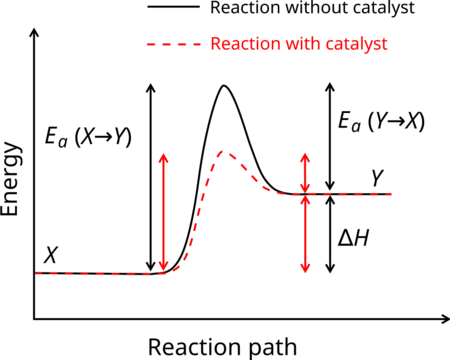
A chemical reaction is fundamentally a rearrangement of atoms, where the positions of electrons shift as bonds form and break between atoms, while the nuclei themselves remain untouched. The starting materials, known as reactants or reagents, undergo this transformation to yield products that typically carry properties distinct from what went in. These processes are not always single events; many unfold through a sequence of elementary steps, and the precise pathway is captured in what chemists call the reaction mechanism. Reactions can be sorted by whether they release heat (exothermic) or demand heat input (endothermic), and by whether oxidation and reduction are at play (redox) or absent (non-redox). The speed at which a reaction proceeds depends on temperature and concentration, with higher temperatures generally accelerating the process by supplying the thermal energy needed to overcome the activation barrier for bond-breaking. All of this is captured symbolically in a chemical equation, which lays out reactants, products, and sometimes intermediates and conditions.
From Alchemy to Industry
The practical manipulation of chemical transformations stretches back to antiquity, when humans harnessed combustion, fermentation, and the reduction of ores to extract metals. Greek thinkers like Empedocles proposed that all matter was woven from four elemental substances—fire, water, air, and earth—setting the stage for centuries of speculative theory. Medieval alchemists pushed further, attempting to transmute lead into gold through reactions with sulfur, and achieving genuine syntheses such as ammonium chloride from organic materials, a feat attributed to Jābir ibn Ḥayyān around the ninth century. By the fourteenth century, alchemists were producing sulfuric and nitric acids by heating sulfate and nitrate minerals. The seventeenth century brought Johann Rudolph Glauber's production of hydrochloric acid and sodium sulfate.
Shattering Old Paradigms
In parallel, the boundary between organic and inorganic chemistry seemed impenetrable; vitalism held that living matter possessed a special vital force making it impossible to synthesize organic compounds from inorganic starting materials.
Life's Engine and Beyond the Atom
Within living cells, chemical reactions are strung together into metabolic pathways, where the product of one step becomes the reactant of the next. These cascades are typically catalyzed by protein enzymes, which dramatically accelerate reaction rates so that syntheses and decompositions that would be impossible under ordinary conditions can proceed at the modest temperatures and concentrations found inside a cell. Beyond the molecular world, the very concept of a chemical reaction has been broadened to encompass processes involving entities smaller than atoms. Nuclear reactions, radioactive decays, and interactions between elementary particles—described by quantum field theory—now fall under the umbrella of chemical transformation. In nuclear chemistry specifically, both electronic and nuclear changes can occur simultaneously, blurring the classical boundary that restricted chemical reactions to electron rearrangements alone. This expansion reflects how the field has grown from tracking bond-breaking between atoms to describing the most fundamental interactions in nature.
Frequently Asked Questions
What is Valence bond theory and how does it work?
Valence bond theory is a quantum-mechanical framework that describes chemical bonding as the overlap of half-filled valence atomic orbitals from separate atoms. Rather than treating the molecule as a single delocalized entity, it builds the picture bond-by-bond, making the process of bond formation feel intuitive and localized.
How does Valence bond theory differ from Molecular orbital theory?
Where MO theory spreads electrons across the entire molecule, VB theory keeps each bond tied to a specific pair of overlapping atomic orbitals. This localized, bond-by-bond perspective makes VB especially well-suited for visualizing covalent bonds, resonance structures, and hybridization patterns.
Why does Valence bond theory matter for understanding reaction mechanisms?
Because VB theory pinpoints which specific orbitals overlap and how electron density shifts between resonance contributors, it gives mechanists a clear, localized picture of bond breaking and bond making at each step. That intuitive, bond-by-bond view is why it remains a go-to tool for rationalizing transition states and activation barriers in kinetics.
More in Reaction Mechanisms And Kinetics 25-35
Elsewhere in the Reaction Mechanisms And Kinetics universe
Spotted an error? Know more?
This is a living reference — every entry is fact-audited, and reader corrections feed straight into our audit queue. Suggest an edit · See this site's audit record