Transition state theory
Theory explaining reaction rates via activated complexes.

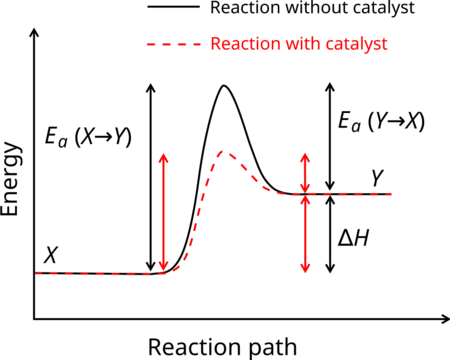
Transition state theory (TST) explains the reaction rates of elementary chemical reactions by assuming a quasi-equilibrium between reactants and activated transition state complexes. It is used primarily to understand qualitatively how chemical reactions take place and has been successful in calculating thermodynamic activation parameters such as standard enthalpy, entropy, and Gibbs energy of activation.
- field
- Chemistry
- known_for
- Transition state theory (activated-complex theory, absolute-rate theory)
- developed_by
- Henry Eyring, Meredith Gwynne Evans, Michael Polanyi
Lore & Background
The theory assumes a special type of chemical equilibrium (quasi-equilibrium) between reactants and activated transition state complexes. It is also referred to as activated-complex theory, absolute-rate theory, and theory of absolute reaction rates. Before TST, the Arrhenius rate law was widely used to determine energies for the reaction barrier. The Arrhenius equation derives from empirical observations and ignores mechanistic considerations. TST, which led to the Eyring equation, successfully addresses the two parameters associated with the Arrhenius law: the pre-exponential factor and the activation energy. The basic ideas behind TST are that rates of reaction can be studied by examining activated complexes near the saddle point of a potential-energy surface, that these complexes are in quasi-equilibrium with reactant molecules, and that kinetic theory can be used to calculate the rate at which they convert into products. Three approaches contributed to its development: thermodynamic treatment, kinetic-theory treatment, and statistical-mechanical treatment.
Reader's Guide
Transition state theory is significant because it provided a theoretical framework for understanding chemical reaction rates beyond the empirical Arrhenius equation. By introducing the concept of a quasi-equilibrium between reactants and activated complexes, TST allowed chemists to calculate thermodynamic activation parameters—standard enthalpy, entropy, and Gibbs energy of activation—from experimentally determined rate constants. Although TST was less successful in its original goal of calculating absolute reaction-rate constants due to the need for precise knowledge of potential-energy surfaces, it remains a cornerstone for qualitative understanding of reaction mechanisms. The theory unified earlier work by van 't Hoff, Arrhenius, Marcelin, Kohnstamm, Scheffer, and Brandsma, and addressed the physical interpretation of the pre-exponential factor and activation energy. Its legacy includes the Eyring equation and continued use in chemical kinetics to interpret how reactions proceed through transition states.
Did You Know?
- The theory assumes a special quasi-equilibrium between reactants and activated transition state complexes.
- TST is also called activated-complex theory, absolute-rate theory, and theory of absolute reaction rates.
More in Reaction Mechanisms And Kinetics 1-24
Elsewhere in the Reaction Mechanisms And Kinetics universe
Spotted an error? Know more?
This is a living reference — every entry is fact-audited, and reader corrections feed straight into our audit queue. Suggest an edit · See this site's audit record