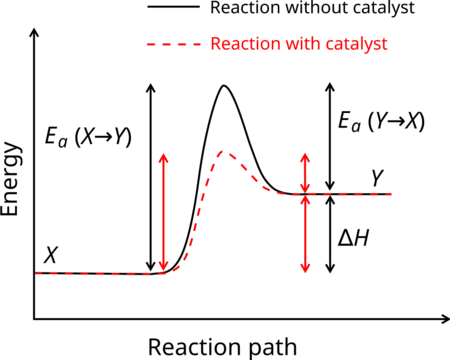
Reaction coordinate
Abstract coordinate representing progress along a reaction pathway.

A reaction coordinate is an abstract one-dimensional coordinate used in chemistry to represent progress along a reaction pathway. It is typically a geometric parameter, such as bond length or bond angle, that changes during the conversion of molecular entities, and is central to understanding reaction mechanisms and energy profiles.
- field
- Chemistry
- known_for
- Parameterizing reaction progress along a pathway
- related_concepts
- Transition-state theory, potential energy surface, collective variables, order parameters
Lore & Background
In chemistry, a reaction coordinate is chosen to represent progress along a reaction pathway, often as a geometric parameter like bond length or bond angle. For example, in the homolytic dissociation of molecular hydrogen, the bond length serves as an apt coordinate. Non-geometric parameters such as bond order are also used, though direct representation can be difficult for complex reactions. In computer simulations, collective variables are employed for target-oriented sampling, reducing many individual variables into a lower-dimensional set that describes crucial system characteristics. These collective variables span the reaction coordinate with a continuous function, and applying a bias to them enables enhanced simulations that can 'steer' toward desired destinations. Special collective variables that distinguish reactants from products are known as order parameters, a term originating in phase transition work. Reaction coordinates are special order parameters that describe the entire pathway from reactants through transition states to products. They may be defined using chemically intuitive variables like bond lengths, splitting probabilities (committors), or eigenfunctions corresponding to reactant-to-product transitions.
Reader's Guide
The reaction coordinate is a foundational concept in chemical kinetics and computational chemistry, as it parameterizes reaction progress at the molecular level. It differs from extent of reaction, which measures progress in terms of system composition. In transition-state theory, the reaction coordinate for each step is one of a set of curvilinear coordinates that leads smoothly from reactants to products via the transition state, typically following the path defined by the potential energy gradient—shallowest ascent and steepest descent. Free energy is often plotted against reaction coordinates to show potential energy profiles. The concept enables the study of rare events in simulations by using collective variables and enhanced sampling techniques, making it indispensable for understanding and predicting chemical reactivity.
Did You Know?
- A reaction coordinate is an abstract one-dimensional coordinate chosen to represent progress along a reaction pathway.
- In the homolytic dissociation of molecular hydrogen, an apt reaction coordinate is the bond length.
- Reaction coordinates are special order parameters that describe the entire pathway from reactants through transition states to products.
- In transition-state theory, the reaction coordinate is typically chosen to follow the path defined by the potential energy gradient – shallowest ascent/steepest descent – from reactants to products.
Frequently Asked Questions
What is Reaction coordinate?
It is a one-dimensional abstract variable that tracks how far a chemical system has progressed from reactants to products along a specific pathway. Think of it as a single number summarizing the 'position' of a molecule mid-transformation.
What does Reaction coordinate actually measure in practice?
It is typically tied to a geometric descriptor—such as the distance between two atoms or the angle at a particular atom—that shifts as bonds break and form. This compresses the full multidimensional motion of a reaction into one trackable parameter.
How does Reaction coordinate fit into Transition-State Theory?
It supplies the axis along which potential energy is plotted, exposing the energy barrier (the transition state) that separates reactants from products. Without this coordinate, the characteristic energy 'hill' of a reaction has no direction to climb.
Why do kinetics fans consider Reaction coordinate essential?
It lets chemists reduce a complex, many-atom rearrangement to a single progress variable, making rate calculations and mechanism analysis tractable. It is the backbone of how we visualize and quantify both how fast and how a reaction proceeds.
Which concepts are most closely linked to Reaction coordinate?
It sits at the intersection of transition-state theory, the potential energy surface, collective variables, and order parameters. Together these ideas form the core toolkit for mapping and interpreting a reaction's energetic landscape.
More in Reaction Mechanisms And Kinetics 1-24
Elsewhere in the Reaction Mechanisms And Kinetics universe
Spotted an error? Know more?
This is a living reference — every entry is fact-audited, and reader corrections feed straight into our audit queue. Suggest an edit · See this site's audit record