Reversible reaction
A reaction where forward and reverse conversions occur simultaneously.

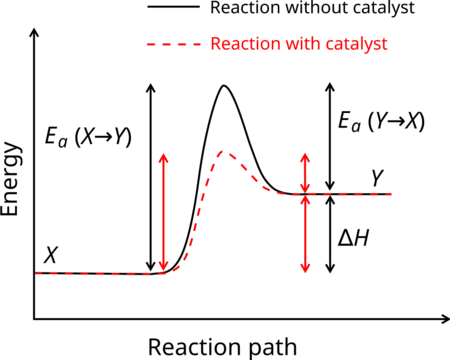
A reversible reaction is a chemical reaction in which the conversion of reactants to products and the conversion of products to reactants occur simultaneously. Until then, chemical reactions were thought to always proceed in one direction.
- field
- Chemistry
- known_for
- Introducing the concept of reversible reactions
- key_contributors
- Claude Louis Berthollet, Peter Waage, Cato Maximilian Guldberg, Le Chatelier, Braun
Lore & Background
He recognized this as the reverse of the familiar reaction Na2CO3 + CaCl2 → 2 NaCl + CaCO3. Until then, chemical reactions were thought to always proceed in one direction. Berthollet reasoned that the excess of salt in the lake helped push the 'reverse' reaction towards the formation of sodium carbonate. In 1864, Peter Waage and Cato Maximilian Guldberg formulated their law of mass action which quantified Berthollet's observation. Weak acids and bases undergo reversible reactions. For example, carbonic acid: H2CO3(aq) + H2O(l) ⇌ HCO−3(aq) + H3O+(aq). The concentrations of reactants and products in an equilibrium mixture are determined by the analytical concentrations of the reagents and the equilibrium constant, K. The magnitude of the equilibrium constant depends on the Gibbs free energy change for the reaction.
Reader's Guide
Reversible reactions are fundamental to understanding chemical equilibrium and are distinct from reversible processes in thermodynamics. The law of mass action, formulated by Peter Waage and Cato Maximilian Guldberg in 1864, provided a quantitative basis for Berthollet's observations. In a reversible reaction, the forward and reverse reactions occur simultaneously. The equilibrium constant K depends on the Gibbs free energy change; when the free energy change is large (more than about 30 kJ·mol−1), the equilibrium constant is large and the concentrations of reactants at equilibrium are very small. Such a reaction is sometimes considered irreversible, though small amounts of reactants are still present. A truly irreversible chemical reaction is usually achieved when one of the products exits the reacting system, such as carbon dioxide gas escaping from a reaction mixture. The kinetics of reversible reactions can be described mathematically. For the simple case A⇌B, the forward rate constant k1 and reverse rate constant k-1 determine how concentrations change over time, eventually reaching equilibrium concentrations that depend on the ratio of these rate constants.
Did You Know?
- Until Berthollet's observation, chemical reactions were thought to always proceed in one direction.
- Peter Waage and Cato Maximilian Guldberg formulated the law of mass action in 1864 to quantify Berthollet's observation.
Frequently Asked Questions
Who is Reversible reaction?
Reversible reaction is the chemistry concept in which reactants convert to products while products simultaneously convert back to reactants. It overturned the long-held belief that every chemical transformation marches strictly in one direction.
What are Reversible reaction's powers/role?
Its defining power is running the forward and reverse conversions at the same time, so the system never truly commits to one side. This two-way churning is what ultimately produces a state of chemical equilibrium.
How does Reversible reaction's story end?
The arc reaches its climax when the forward and reverse rates become equal, locking concentrations into a steady balance. The molecules keep reacting in both directions indefinitely, so the story never truly stops—it just settles into a dynamic stalemate.
Who are Reversible reaction's key allies?
The supporting cast spans Berthollet, who first named the phenomenon, and later Guldberg, Waage, Le Chatelier, and Braun, who developed the quantitative laws and predictive tools around it. Together they elevated a curious lake-side observation into a pillar of both kinetics and thermodynamics.
More in Reaction Mechanisms And Kinetics 1-24
Elsewhere in the Reaction Mechanisms And Kinetics universe
Spotted an error? Know more?
This is a living reference — every entry is fact-audited, and reader corrections feed straight into our audit queue. Suggest an edit · See this site's audit record